
📖 8 Minute Read | Performance Psychology | Article by Veronica Start

I think it’s safe to say that every singer is acquainted with occasional or chronic feelings of dread when we’re called to the stage. In fact, about 75% of the population experiences some form of anxiety or nervousness before performing in front of an audience. Even famous performers admit to experiencing performance anxiety, yet they still deliver outstanding performances.
Perhaps it’s because they’ve learned that their symptoms will begin to settle after the first song or two. Over time, they’ve discovered their own way of managing stage fright. But will their approach work for you?
As the old saying goes, feel the fear and do it anyway.
Well, that’s easy enough to say. But how do we do it anyway? How do we continue singing when our body feels like it’s working against us? How do we develop genuine confidence instead of simply hoping the fear will disappear?
It’s important to remember that stage fright is a temporary state arising from the interaction among your nervous system, your perceptions, and your past experiences.
Once you understand why your body reacts the way it does, you’ll be in a much better position to work with your nervous system instead of fighting against it.
In this article, we’ll explore the science behind stage fright and discover practical ways to reduce its intensity so you can perform with greater confidence, clarity, and freedom.
What's Happening in My Body?
“His palms are sweaty, knees weak, arms are heavy…” - Eminem (Lose Yourself)
We usually associate stage fright with symptoms such as sweaty palms, a dry mouth, muscle twitches, trembling, and a pounding heartbeat. Another common experience is “choking,” where your performance is suddenly interrupted, and you feel as though your voice, memory, or confidence has abandoned you. In more extreme situations, the urge to escape can become so overwhelming that a performer may run off stage or, in rare cases, even faint.
Athletes experience a similar phenomenon when the pressure to perform exceeds their perceived ability, causing them to “choke” under stress.
Although these reactions can feel alarming, they are signs that one of your body’s built-in survival systems has been activated.
This system is called the sympathetic nervous system, more commonly known as the fight or flight response. Its purpose is to prepare you to respond to danger.
Thousands of years ago, that danger may have been a predator.
Today, it might be an audience waiting expectantly for you to sing.
Your nervous system doesn’t always distinguish between physical danger and emotional vulnerability. If it interprets a situation as threatening, it prepares your body to protect you in the same way.
The good news is that this system isn’t your enemy. It’s simply trying to keep you safe. Since it operates automatically, we can’t stop it from existing. We can, however, learn to understand it, work with it, and gradually reduce the triggers that activate it.
Think about the moment before you walk onto a stage. You see the audience waiting. You hear the room grow quiet. Your heart suddenly begins to race. Even imagining that moment can trigger physical symptoms.
It may feel irrational because the reaction happens so quickly, almost as if it occurs without your permission. In many ways, that’s exactly what’s happening.
These reactions are controlled by your Autonomic Nervous System (ANS), which regulates involuntary processes such as your heart rate, breathing, blood pressure, digestion, and many other essential bodily functions.
So how is the Autonomic Nervous System activated in the first place?
It all begins in your brain and your mind.
What's Happening in My Brain?
The brain is a physical organ, and our physical health, personal history, and life experiences all influence how well it responds to stress and performs under pressure.
It’s well documented that the demands of modern life can affect our mental wellbeing, contributing to feelings of overwhelm, anxiety, and fatigue. Our brains weren’t designed for the constant stream of information, notifications, and demands that compete for our attention every day. At least they haven’t evolved that far…yet.
The good news is that our brains have an incredible ability known as neuroplasticity. This means the brain can continue to adapt by forming new connections and reorganizing existing ones throughout our lives. Although this ability naturally changes as we age, awareness, self-care, and consistent practice can help support our brain’s capacity to learn new patterns and responses.
This is encouraging news for anyone who struggles with stage fright. It means your current reactions are not necessarily permanent. With time and the right approach, your brain can learn a different response.
Developing new neural pathways doesn’t happen overnight. It takes repetition, patience, and adequate rest for the brain to strengthen these new connections. That’s one reason good sleep hygiene is so important. Sleep supports learning, memory, overall brain health, and, of course, great singing.
Keeping the Brain in Mind
Understanding the brain is only part of the picture. To better understand stage fright, it also helps to distinguish between the brain and the mind. While scientists continue to explore exactly how the two relate to one another, it can be helpful to think of the brain as the physical structure and the mind as our inner experience of thoughts, emotions, reasoning, and awareness.
For the purposes of this article, we’ll use this distinction because it helps explain why stage fright involves both physical reactions and mental processes.
Neurologists understand that networks of neurons form the complex circuits that make thinking, feeling, learning, and memory possible. These interconnected systems provide the foundation for our conscious experience. If you’d like to explore this fascinating topic further, I recommend the research article: A Neurologist Looks at Mind and Brain: “The Enchanted Loom.”
How We Detect Stage Fright
Let’s return to the Autonomic Nervous System (ANS), which is responsible for the physical symptoms of stage fright.
Your nervous system is constantly assessing your surroundings for signs of safety or danger. It does this by comparing what is happening in the present with memories and experiences stored below your conscious awareness. When a situation is interpreted as threatening, your nervous system responds automatically to protect you.
You can think of this process as an internal surveillance system. It’s quietly scanning your environment, reading people’s expressions, interpreting situations, and comparing them with your past experiences. All of this happens outside your conscious awareness and in a fraction of a second.
According to Polyvagal Theory, this unconscious process is called neuroception. Neuroception continuously evaluates cues of safety and danger, helping to regulate your Autonomic Nervous System (ANS).
In other words, your nervous system is constantly asking one simple question:“Am I safe?”
If the answer is yes, your body remains relatively calm.
If the answer is no, your nervous system prepares you to protect yourself, even if the danger is only perceived rather than real.
If you’d like to learn more about Polyvagal Theory and neuroception, here is a short introductory video.
This protective system developed very early in human evolution to help us survive predators and other life-threatening situations. While our world has changed dramatically, our nervous system still responds to emotional vulnerability much like it once responded to physical danger.
This is why simply imagining an audience, remembering a painful performance, or anticipating criticism can trigger the same physiological response as a genuine threat. Your nervous system isn’t trying to sabotage you. It’s trying to protect you.
An important point to remember is that our level of vigilance is often influenced by the number and intensity of difficult experiences we’ve accumulated throughout our lives.
These experiences are stored outside our immediate awareness in the subconscious mind.
The Archive of Harm
I use the phrase Archive of Harm as a metaphor to describe the collection of painful memories, disappointments, losses, and interrupted expectations we accumulate throughout life.
Imagine a vast archive where life experiences are carefully stored away for future reference.
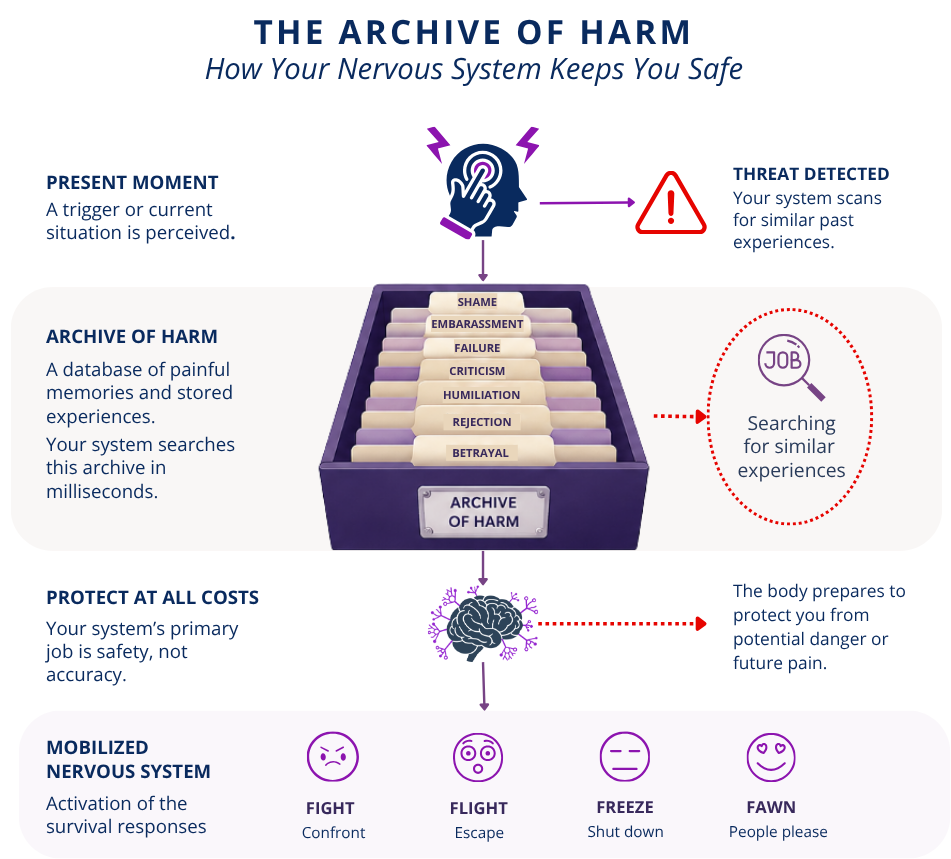
When a distressing experience isn’t fully processed, healed, or safely witnessed, your nervous system remembers it. If a future situation shares similar emotional cues, neuroception may interpret it as a potential threat and activate your protective response.
In other words, experiences that overwhelm us, frighten us, shame us, or leave us feeling unsafe don’t simply disappear. They can become part of the subconscious patterns carried in the body, influencing how we respond in the future.
This doesn’t mean we’re trapped by our past.
It simply means our nervous system is doing exactly what it was designed to do: learning from experiences in an effort to keep us safe.
In some cases, longer-term distressing experiences or trauma can leave our nervous systems particularly hypervigilant. As a result, present-day situations may contain reminders, or even subtle nuances, that resemble experiences stored in our Archive of Harm. When that happens, our minds and bodies can automatically shift into a fight or flight response.
This means there will be times when our reactions are not proportionate to our present reality. Our nervous system isn’t responding only to what’s happening now. It’s also responding to what it has learned from the past.
The Trauma Spectrum
Trauma exists on a wide spectrum, ranging from repeated experiences that hurt our feelings to serious events such as accidents, abuse, or prolonged neglect. Some experiences are so overwhelming that they become deeply embedded in our subconscious, influencing how we perceive safety long after the event has passed.
These more complex experiences often require the support of qualified mental health professionals, and it’s important to recognize when that kind of help is needed.
Thankfully, most singers don’t need years of therapy to gain a greater sense of control over stage fright.
What we do need is a better understanding of how our nervous system works.
Having anxious thoughts, uncomfortable emotions, or physical reactions does not mean you’re flawed, weak, or dysfunctional. In many cases, stage fright is evidence that your nervous system is doing exactly what it was designed to do: protect you from what it perceives as potential harm.
The goal isn’t to eliminate this protective system. The goal is to help it recognize when you’re genuinely safe.
So how do we begin calming an anxious nervous system when our thoughts are racing and our body feels out of control?
To answer that, we’ll look at the relationship between two important parts of ourselves: our conscious and subconscious mind.
The Fearful Child
Think about how we comfort a child who believes there’s a monster hiding under the bed.
It’s important that we don’t begin to approach this with logic.
We first need to acknowledge that the child is frightened. We offer reassurance, comfort, and a sense of safety. Only after the child begins to settle do we gently introduce reality and explain that the monster isn’t there.
The order matters because a frightened child cannot be reasoned with until they first feel safe.
The same principle applies when our subconscious mind becomes activated.
When stage fright takes over, the emotional part of us reacts much like that frightened child. Before we can think clearly or solve problems, we first need to help our nervous system settle into a state of safety.
One way to think about this is to imagine your conscious mind as the compassionate adult, and your subconscious mind as the frightened child.
The adult’s role isn’t to criticize or suppress the child. Its role is to listen, reassure, and gently restore a sense of safety.
Only then can we begin using logic, planning, and problem solving effectively.
This is one example of what psychologists sometimes describe as cognitive defusion: learning to observe our thoughts and feelings rather than becoming overwhelmed by them. Instead of accepting every fearful thought as truth, we can pause, check in with ourselves, and allow our conscious mind to regain executive control.
Now, this is where overcoming stage fright truly begins.
The first step is to bring the subconscious reactions of our “fearful child” into compassionate awareness so we can create a calmer, more regulated state.
The second step is to use our conscious mind to examine the practical concerns that may be contributing to our fear.
But what happens when the adult part of you feels confused too?
What if your conscious mind is full of unanswered questions?
What if you’re not sure how to reassure the child because you don’t yet have the answers yourself?
Let’s look at that next.
The Confused Adult
While the “adult” part of us understands real concerns, actions, and consequences, our conscious mind can also become overwhelmed by unanswered questions, uncertainty, and self-doubt. When that happens, it struggles to reassure the frightened part of us that’s looking for safety.
Your body is reacting, your mind is racing, and suddenly everything feels chaotic.
This is why overcoming stage fright isn’t just about calming the subconscious. We also need a practical plan to calm the conscious mind.
The conscious mind functions like a problem solver. Whenever it encounters uncertainty, it automatically begins searching for answers, assessing risks, and imagining possible outcomes. Left unchecked, this process can easily spiral into worry and overthinking.
Fortunately, the conscious mind is reassured by answers.
Many aspects of stage fright can be reduced simply by identifying the unknowns and replacing them with preparation. In other words, we create peace by turning uncertainty into a plan.
You may already know the answers to many of the questions racing through your mind. Sometimes your thoughts simply become cluttered under pressure. Writing your concerns down and working through them logically helps restore a sense of order and perspective.
Preparation isn’t just about becoming more organized. It’s also an act of self-care.
Due Diligence
Preparing for a performance involves far more than learning the music. There are countless details to consider, especially if you’re less experienced or performing in an unfamiliar environment.
Due diligence simply means taking the time to thoughtfully and carefully prepare for the things that matter.
It isn’t about perfection.
It’s about reducing unnecessary uncertainty.
When we’re already feeling nervous, it’s easy to overlook important details. Those overlooked details often become the very things our minds fixate on before we walk on stage. On the other hand, when we’ve prepared thoroughly, we give our conscious mind evidence that we’ve done everything reasonably possible to succeed.
Neglecting our preparation can leave us with a nagging sense that we’ve forgotten something important. That guilty conscience creates even more uncertainty, feeding the cycle of anxiety.
Many of us have learned through experience that poor preparation has real consequences.
The good news is that most of the questions our conscious mind asks are practical, and they’re usually solvable.
For almost any performance, those questions can be organized into three simple categories:
Music:
- Do I know these songs well?
- Do I have the right repertoire?
- Who is the accompanist?
- Are there rehearsals?
Abilities:
- Is this song within my range and abilities as they stand right now?
- Who can I talk to about it?
- Do I have time to practice?
- What's expected of me?
Environment:
- Who is the audience?
- What's the venue like?
- What is the sound equipment like?
- Who can I talk to about it?
Once we organize our concerns this way, they become far less overwhelming.
Instead of facing one large cloud of anxiety, we’re simply solving a series of manageable problems.
Your Personal Performance Plan
Now let’s bring everything together.
We’ve learned that some of our anxiety comes from our subconscious mind, where past experiences influence our sense of safety. We’ve also seen that our conscious mind becomes anxious when it’s faced with uncertainty and unanswered questions.
Both deserve our attention.
Your subconscious needs reassurance and a sense of safety.
Your conscious mind needs answers.
As you prepare for a performance, think about both. Take time to address the practical concerns you can solve in advance, while also developing a few simple grounding strategies to help calm your nervous system when those familiar feelings of nervousness arise.
To make this easier, I’ve created the Stage Fright Mind Map, which brings these ideas together into one practical visual framework. If you’d like more structured guidance, the Mastering Stage Fright Workbook expands on these concepts with step-by-step exercises and planning tools.


Mastering Stage Fright - The Ultimate Gig-Prep Workbook
The next time those fearful feelings begin to build, come back to your performance plan and refine it as you gain experience. It may take a little extra organization at first, but before long these habits become second nature.
Yes, you’re human, and you will still experience flashes of doubt, worry, and stress. But with self-care, thoughtful preparation, and practice, those stage fright triggers will gradually diminish in both duration and intensity because they are no longer a mystery.
Remember: Whenever you can name it, you can tame it.
With self-care and practice, you can gradually remove the power that stage fright has over you, allowing your attention to return to what truly matters: sharing your voice and music.
- Veronica Start
© 2026 Soul Singer Assertiveness Coaching | Veronica Start